
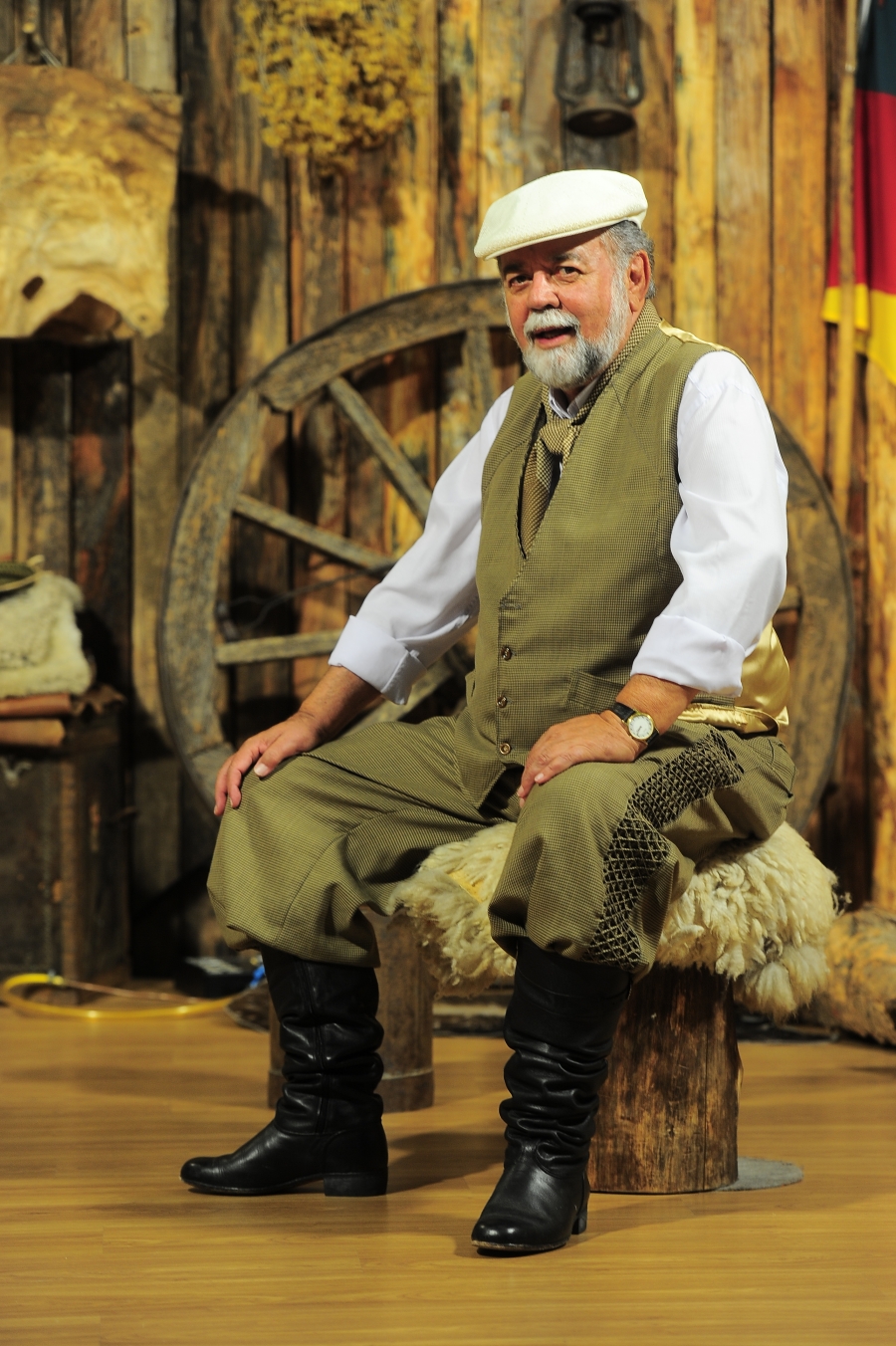
Luiz Carlos de Lucena
18/02/1942
-26/10/2018
Luiz Carlos de Lucena spent his childhood surrounded by the nature of Cazuza Ferreira. One of his favorite activities was something that children today do not know: making expeditions into the woods. On these adventures, Lucena would collect fireflies and put them in a glass jar. He would take them home and stay there, tirelessly, watching them light up and go dark. His mother, upon discovering the imprisoned fireflies, forced her son to return them to the woods, thus giving rise to the title of the last book he would write, many years later, “Apaguei a luz do vagalume” (I Put Out the Firefly's Light).
Lucena wrote five books. But he had stories and tales enough to write many more.
Born in 1942, he attended school up to middle school, but he was a rebellious student. He went to classes because his parents made him.
In the late 1950s, still a boy, Lucena was reciting a poem at a CTG (a traditional gaucho center) when his good oratory caught the attention of an announcer, who invited him to work at Rádio Clube de Canela. It was his first job in the field.
Later, the family moved to Caxias do Sul, where he joined Rádio Caxias. Next to his colleagues, Lucena was just a kid. His career was only beginning.
After radio, he worked at TV Caxias, the Pioneiro newspaper and UCS TV. Among the most memorable moments of his journey in the media is his participation in the first color TV broadcast in Brazil, when all eyes turned to Caxias do Sul, during the 1972 Grape Festival. The event was a source of pride for him.
Lucena's career had two great phases. After 30 years as a broadcaster, he worked for more than 30 as an institutional relations advisor at Viação Santa Tereza, Visate. In both, he was involved with his two passions, communication and community. These two words had everything to do with him.
He began his career at Visate even before the company was established in Caxias. He even took part in choosing the site. So he had more years of activity at Visate than the company itself (at each Visate anniversary, he celebrated being one year older than it). It was no wonder he was known as “Lucena from Visate”, as if “from Visate” were almost a surname.
Lucena was one of those people who knew everyone. And everyone knew him. He never went out on the street without meeting someone and stopping for a few minutes to chat. Outgoing and friendly, he was genuinely interested in people. He gave them a lot of attention, never said no, was always available. He did this with everyone, from the neighborhood representative to the city's biggest businessman. He had many friends, from different circles. He loved parties, dances and events. His musical style was rancheira and he was a fan of César Passarinho.
Lucena was married for 35 years to Mari Helena (they married at the CTG Rincão da Lealdade). They had four children, Fabiana, Renata, Claudia and Tiago. To them, he taught the importance of honesty and humility, traits he followed in his own journey.
His second marriage, to Eliana, lasted 18 years. He began to write, as a hobby, to pass the time. As a good traditionalist, he wrote tales. Eliana suggested: “Why don't you put that in a book?” Lucena liked the idea. And there were so many tales that one book turned into five. And he used to joke: “With Mari Helena I had four children. With Eliana, it was five books.”
For the efforts of so many years of work and dedication, Lucena received the title of Honorary Citizen of Caxias, in 2007; a chair at the Caxias Academy of Letters, in 2008; the ARI Serra Gaúcha Trophy, in 2012; in addition to other honors, whose medals and plaques he kept proudly at home.
He was recognized as an important figure in the community, but he was especially important to his family. A fan of barbecue (obviously) and of a good tripe stew, Lucena was the creator of the “Lucena Rodeo”, a family gathering that featured a great feijoada. He spent days planning (and chopping the ingredients) for that big pot.
Another passion was travel. And he was a professional who truly wore the company's colors: once, he sent a photo to his children from a public market in Spain wearing his Visate jacket. At the Eiffel Tower, he took a photo with a red gaucho scarf and a beret. He was a person with personality.
He was always very humble, thinking more of others and less of himself. He said he did not want any tributes after his death. So much so that, when an idea was proposed to name a street after him, the family felt it would not suit their father, who did not like the spotlight. But they accepted the other suggestion: in 2023, five years after his passing, Lucena now lends his name to the House of Reading, Memory and Legislative Education of the City Council of Caxias do Sul. A tribute in the so-called House of the People and within a space dedicated to valuing the written word, something he held so dear. Moreover, there is another special meaning for the family: at the Council, there is also a press room, which honors a great friend of his and colleague in the field of Communication, Paulo Cancian. They would certainly have liked this closeness.
Lucena believed that “living in peace with everyone” was always the best alternative. And so he did. Nothing ruffled him. Perhaps that is why, whenever he looked back, he felt no regret at all. “I would do it all again,” he used to say.
Lucena departed in October 2018 and, to honor his journey, the farewell had what he liked most: lots of people gathered together. Everyone was left with the memory that life should indeed be lived as he taught, easygoing and in peace.
Photo credit: Porthus Junior
Text: Valquíria Vita, Legado Histórias de Vida
Would you like to immortalize the story of your loved one who has passed away? Get in touch with Legado: 54 997114447